Synchronous L1-L2 composability asks a rollup to share ordering with Ethereum's block builder at the moment of a cross-domain call, and to reorg together with Ethereum. For a general-purpose L2 that is a margin problem, because ordering is where its revenue and its control over MEV sit. For an operational rollup in supply chain or traceability it costs almost nothing, since that rollup never monetised its sequencer in the first place. What it gets back is the right to stop rebuilding the on-chain half of a financial layer: money stays on L1, the process moves to L2, and the two settle atomically within one L1 block.
The Ethereum Economic Zone (EEZ) is marketed as a fix for liquidity fragmentation between general-purpose L2s. My argument is that it suits a different class of rollup much better, and that the reason is economic.
Checked against public EEZ materials, Gnosis governance documents and Ethereum mainnet activity as of 11 October 2026. Facts carry a source. Where a sentence is my own assessment, it says so.
Why would anyone need synchronous L1-L2 composability?
A rollup needs synchronous L1-L2 composability when it has to move value to or from Ethereum in the same step as its own logic, without a bridge in between. Without it, every value movement between a rollup and Ethereum is a bridge transfer with its own delay, its own trust model and the failure modes I described in what breaks when volume hits a bridge. A reader under my Telegram post about the EEZ asked the blunt version: why bother. The news had been framed as "Ethereum made moving between layers easier", which invites exactly that reaction. If all you want is to move tokens, bridges already do it.
The better question is who needs a single atomic call across L1 and L2 badly enough to pay what it costs. Paying means accepting Ethereum's ordering at the boundary, Ethereum's reorgs, and a dependency on a prover that has to keep up in real time. Some rollups pay that easily. Some will refuse. The split does not follow the line most coverage draws.
What did the Ethereum Economic Zone actually demonstrate on 5 October 2026?
The Ethereum Economic Zone demonstrated a single 0.001 ETH call from Ethereum mainnet into an EEZ rollup, executed and proven within one L1 block. That is a real milestone and a narrow one.
The EEZ is a framework built by Gnosis and the ZisK team with co-funding from the Ethereum Foundation. Participating rollups adopt it, and Ethereum itself did not change. It was announced on 29 March 2026 around EthCC in Cannes, covered by The Block and CoinDesk, and presented in the EthCC talk "Rollups broke Ethereum, but we can fix it". The founding members named at launch were Aave, Titan, Beaver Build, Centrifuge and xStocks.
The mechanism, per the EEZ technical write-up and the Gnosis Q2 2026 report, works in four steps. An L1 proxy is created for a contract that lives on the L2, at an address derived deterministically from the L2 address and chain ID. The proxy checks every call against an execution table that the block builder or composer prepared in advance. The L2 state transition behind that table is proven with a zero-knowledge proof. If something fails, a deferred revert unwinds the affected entries. Static cross-chain calls were merged in Q2 as well.
The user's transaction landed in block 26,127,444 on 5 October 2026. It moved 0.001 ETH from L1 to L2, used 111,263 gas and cost about $0.80. Earlier in the same block, the composer posted the execution entry and its proof in a separate postAndVerifyBatch transaction that cost about $2.18. So the demonstration cost roughly $3 at that day's gas price. One of the EEZ core developers described it on X as the moment atomic synchronous composability became "no longer a promise".
What it did not show matters as much. It was one direction, L1 to L2, with no nested calls. Two-way and nested calls with real-time proving sit on the 2027 roadmap. The first production instance, on Gnosis Chain, will start with the opposite direction, one-way L2 to L1, under a temporary prover that GIP-153 describes as likely TEE-based. The core repository is marked as not audited.
Does a rollup have to give up its sequencer to join the EEZ?
A rollup joining the EEZ keeps its sequencer for its own blocks and gives up the monopoly on ordering only where a call crosses into Ethereum. The EEZ core protocol repository describes synchronous composability "between based rollups sharing the same L1 sequencer". A reply in the ethresear.ch design thread puts the requirement plainly: a shared sequencer defines one linear order across L1 and the participating L2s, and a cross-domain call outside that order reverts.
In practice there is room between fully based and fully independent. The Gnosis Chain proposal, GIP-153, approved in August 2026, keeps two-second blocks and states that Gnosis Ltd operates the composer that orders transactions. It also says the combination of synchronous composability and fast blocks is "currently only possible in a centralized fashion". Bankless's explainer names reorging together with L1 as the main tradeoff.
So the accurate version of the cost has three parts. A participating rollup accepts Ethereum's ordering whenever a call crosses the boundary. It accepts that an L1 reorg reorgs it too. And it accepts that its cross-domain path works only as long as a proof arrives in time. It can keep its own fast blocks for everything else.
Why will general-purpose L2s hesitate to join the EEZ?
General-purpose L2s will hesitate to join the EEZ because transaction ordering is their business. A general-purpose L2 earns the spread between what users pay in fees and what it pays Ethereum for data, plus whatever it captures from ordering. Sygnum estimated in March 2025 that sequencer revenue over the previous year was roughly $93 million for Base, $42 million for Arbitrum and $26 million for Optimism, figures that are now eighteen months old. Superchain members already share 15% of net fee profit or 2.5% of gross fees, whichever is larger. An August 2026 analysis of the EEZ's revenue model pointed out that the framework has no published rule for how value flows back. For a chain with a working revenue line, that is an open question about margin.
The MEV argument cuts the same way. Arbitrage between an L2 pool and an L1 pool is exactly the flow that synchronous calls make atomic, and atomic flow at the boundary is ordered by whoever builds the L1 block. For a chain whose economics depend on that flow, this is a transfer of value to Ethereum's builders.
There is a precedent for ambition meeting this constraint. In 2024, Polygon's co-founder described AggLayer in terms of synchronous cross-chain calls and a single-chain user experience. The current AggLayer documentation still uses the word atomic, but the mechanism it describes is a unified bridge in which transactions settle on Ethereum before they can be claimed on the destination chain. I could not find an official statement that the model changed. The gap between the 2024 framing and the 2026 documentation is visible all the same.
Why does a supply-chain rollup lose almost nothing by joining the EEZ?
A supply-chain or traceability rollup loses almost nothing by joining the EEZ, because it never earned from its sequencer. An operational rollup for traceability, product passports or logistics records custody handoffs, quality checks, certificates and shipment states. Its fees are an operating cost that the platform owner usually pays on the users' behalf. There is no arbitrage flow to protect and no MEV worth the name in a stream of signed status events.
The three costs from the previous sections mostly do not bind either, in my assessment. Reorging with Ethereum matters less for a process record than for a trading venue, because nothing downstream reprices in seconds. And when a payment and a process step are linked atomically, an L1 reorg reverts both together, which is the property a settlement system wants. Accepting L1 ordering at the boundary matters only for the few calls that cross it. The prover dependency is real, and I come back to it below.
What the operational rollup gets in return is the thing it has always lacked: direct access to money. A shipment can be accepted on the L2 and paid on the L1, in stablecoins that already sit on Ethereum, within the same block. Escrow and settlement contracts stay where the liquidity and the issuers already are. The L2 keeps the process. This is the keeper question applied to infrastructure: Ethereum keeps the record of money, the operational rollup keeps the record of process, and an atomic call removes the reconciliation between them that otherwise becomes a ledger problem of its own.
How much of a supply-chain blockchain budget is the financial layer?
In the supply-chain projects I have scoped, the financial layer was absent from every traceability MVP and became the largest part of the package wherever moving money was the product. The blockchain layer itself was small throughout.
The sample is eight supply-chain and trade projects I scoped in 2025 and 2026. Nobody scopes by layer, so I sorted every work item myself by what it actually does. Infrastructure is one bucket. Blockchain covers contracts, network and indexing. Financial covers payments, stablecoin integration, escrow, settlement, custody, the KYC/KYB and AML that applies to money, and financing. Everything else goes in the last bucket. The shares below are shares of the whole build package.
| Project type | Financial layer, share of the build package | What the financial layer contained |
|---|---|---|
| First-mile product passport for an agricultural commodity | none in the MVP; about a quarter of the second phase | Subscription billing, KYB/KYC, AML screening |
| Product passport for a regulated consumer product | none | None |
| Industrial component documentation integrity | none in the MVP; a few percent in full scope | Payment gateway and licensing |
| Timber traceability from forest owner to carrier | none | None |
| Apparel resale with an on-chain item history | a few percent | Card payments and commissions |
| Equipment marketplace with tokenised financing | about a sixth | Security token, wallets, escrowed fiat payments, KYC/KYB/AML |
| B2B procurement, supply, credit and insurance contracts | a fifth to a third, depending on how shared modules are counted | Wallets, stablecoin gateway, escrowed procurement, credit, insurance |
| Commodity import settlement | about a third, rising past half in a stablecoin-first variant | Ledger, escrow, MPC custody, bank and mobile-money rails, FX oracle, KYC/KYB |
Across the same scopes the blockchain layer took a small slice of the package, usually under a tenth, and infrastructure about the same.
Two readings follow. Where money is the product, the financial layer outweighs the chain many times over. And traceability projects keep money out of the MVP because it is the most expensive layer to build, which leaves them commercially weak. One founder in agriculture put it bluntly: traceability alone is politically safe and economically useless, and what the sector needs is finance. Atomic access to L1 money lowers the price of adding it.
What does the external vendor stack behind a financial layer cost?
The external vendors behind a full financial layer cost a platform roughly $290,000 to $700,000 in the first year and $110,000 to $320,000 a year after that, before any engineering. You rarely see these numbers in a scoping call, since they sit outside the build package and land on the client's side of the invoice. The stack itself is fairly standard: a core ledger and payments platform, institutional MPC custody, on-chain transaction monitoring, KYC and KYB checks, Travel Rule tooling once cross-border transfers are in scope, and an audit of the escrow and settlement contracts. Most of it is licensed by the year or charged per check and per transaction, so the bill grows with volume rather than with the code.
On top of that come per-transaction fees on bank, mobile-money and correspondent rails, and those are set by the partner banks and operators.
Only part of that layer moves to L1. Compliance doesn't move. KYC and AML go wherever the money goes. So do the fiat ramps, the bank and mobile-money rails, and most of the vendor stack above. The part a rollup gets to skip is the on-chain half. That means no stablecoin of its own or bridged copy of someone else's, no escrow and settlement contracts on the L2, no custody of bridged assets, and no reconciling the L2 ledger against the money ledger.
When does keeping money on L1 beat building it on L2?
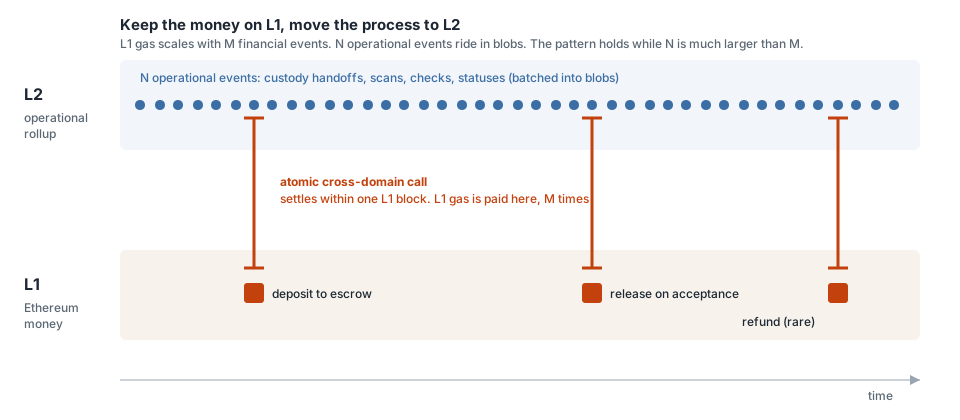
Keeping money on L1 beats building it on the L2 when financial events are rare relative to operational ones and gas stays in its normal range. The rule is easy to test against your own numbers.
Let N be the number of operational events per period and M the number of financial events. Operational events travel inside the rollup's batches, and their L1 cost is the batch overhead plus blob space, shared across all of them. Financial events cross the boundary, and each one pays L1 gas for the cross-domain call.
The mainnet data gives the order of magnitude. A plain postAndVerifyBatch on 11 October used 133,244 gas plus one blob. A batch on 9 October that carried a cross-chain call through a Uniswap V2 pool on L1, swapping about a dollar of WETH into USDC, used 401,272 gas. The batch behind the 5 October demonstration used 297,862, and the user's own call 111,263. So one financial event costs roughly 270,000 to 280,000 gas of L1 execution on top of a plain batch, counting the user's leg where there is one. The gas prices on those days ran from 0.08 to 2.65 gwei. Rounding the top of that range up to 300,000 gas, at 2 gwei and $2,500 per ether one event costs about $1.50. At 0.2 gwei it is about 15 cents. A congested day at 20 gwei would make it about $15.
The rule: keep money on L1 while M multiplied by the L1 cost of one cross-domain call stays below the annual cost of the on-chain financial layer that the rollup would otherwise build and run: the stablecoin or bridge integration, the escrow and settlement contracts, their audits and the reconciliation work.
The simplest way to compare is to flip it around and ask how many calls a budget buys. A cross-domain call runs about $1.50 at 2 gwei. So if building, auditing and running the on-chain half of a financial layer would cost a team $100,000 a year, that same money pays for roughly 67,000 atomic settlements. At 0.2 gwei the same budget buys about 670,000. Put your own figure for that on-chain package into the same arithmetic.
For a supply chain where a shipment generates hundreds of status events and two or three payments (deposit, release, sometimes a refund), the rule holds comfortably at the low gas prices seen this month, and more narrowly at 2 gwei. Take ten thousand financial events a year, which is about 4,500 shipments once you count a deposit and a release for each plus some refunds. In L1 gas that's about $1,500 a year at 0.2 gwei and $15,000 at 2 gwei. If gas somehow sat at 20 gwei all year, you'd pay $150,000. The rule breaks where financial events are frequent: marketplaces settling every order, metered billing, micropayments between machines. Push it to a million payments a year and the bill is around $150,000 at 0.2 gwei, or $1.5 million at 2 gwei. At the lower price that is still in the range of a serious on-chain financial package. At the higher one it is far beyond it. So for a project with high M the break point is a gas price, and it should be modelled before the architecture is chosen.
What are the three constraints that decide whether this works?
Privacy, tempo and the prover decide whether money on L1 with process on L2 works for a given project. Each one can rule the pattern out, so all three belong in the decision before the architecture is chosen.
Privacy. To build the execution table, the composer or block builder has to simulate the L2 execution, which means seeing the L2 data involved. On L1, the CrossChainCallExecuted event in the test transaction exposes the call data, the value and the source address. Batches are posted as Ethereum blobs. I found no mechanism in the published EEZ materials for synchronous calls into private or encrypted state. GIP-153 mentions privacy and compliance modules for regulated clients as future work. Private execution is a common requirement in regulated deployments, and this pattern pulls the other way. It also meets the rule from my piece on product passport data placement: only commitments belong where everyone can read them. Any interface that crosses the boundary has to be designed as public, and for a private rollup the composer has to be the operator or someone the operator trusts.
Tempo. A synchronous call lives in the rhythm of an L1 slot, twelve seconds. Operational systems often want faster acknowledgement: a scan at a warehouse gate, a handoff confirmed on a driver's phone. The Gnosis instance gets two-second blocks by centralising the composer. Preconfirmations are the direction most based-rollup teams are taking. Taiko switched them on in mainnet in August 2025, with whitelisted preconfirmers at launch. They promise inclusion while settlement still waits for L1, and the EEZ team calls its design orthogonal to them. Field operations that are offline-first anyway rarely notice twelve seconds. For anything interactive at the point of payment, the wait can matter.
The prover. The atomic path exists only while a proof arrives inside the window. If proving stalls, the link to money stalls with it, while the L2 keeps producing blocks. Speed is no longer the main worry: on ethproofs, the best real-time cluster, ZisK on eight RTX 5090 cards, now proves Ethereum blocks within the ten-second target almost every time it is online. Liveness is the weaker number, because across the real-time cohort a large share of slots goes unproven when provers are offline. Two caveats apply. Ethproofs tracks proofs of L1 blocks, so it only stands in for EEZ execution tables. And Gnosis's first instance is expected to use a TEE-based prover regardless. So if your design leans on atomic settlement, write down what a payment does when the proof runs late. It can wait in a queue, drop to an asynchronous path, or be refused.
Which architecture should an operational rollup choose?
For an operational rollup, the right place for money depends on three things: how often money moves, how private the data has to be, and how much delay the business will put up with.
| Option | Choose it when | Avoid it when |
|---|---|---|
| Financial layer built on the L2 | Financial events are frequent, data must stay private, or sequencer revenue funds the platform | The project cannot carry the build, licences and compliance operations |
| Money on L1 through an atomic call | N is much larger than M, payment data can be public, twelve-second settlement is acceptable, the sequencer earns nothing | Payment terms or counterparties are confidential, or settlement must be instant |
| Bridge to an L2 stablecoin | Payments are frequent and small, and a bridge's trust model is acceptable for the amounts involved | Amounts are large enough that bridge risk dominates |
| Asynchronous aggregation (claim after L1 settlement) | Payment and process can be minutes apart, and the stack is already in an aggregation network | Release of goods and release of funds must happen in one step |
All of this assumes the money is a stablecoin already living on Ethereum. When the asset is native to some other chain, you have to pick a bridge model first, and only after that does this table apply.
How can you check this for your own project?
You can check whether keeping money on L1 and the process on an EEZ rollup fits your project in less than a day, with three measurements.
Start with N and M. Pull a month of real operations for one process and count two things separately: events that change custody or status, and events that move money. If money events come to more than a few percent of the rest, the rule above gets shaky fast.
Then price a cross-domain call. The easiest way is Etherscan: open a postAndVerifyBatch from the EEZ composer whose logs include CrossChainCallExecuted, take away the gas of a plain batch, add the user's transaction when the call goes from L1 to L2, and multiply by the gas price in your budget.
Last, look at what your sequencer earns. For an operational rollup the answer is usually nothing, and then the main economic argument against synchronous composability simply isn't your problem. Privacy, tempo and the prover are.
What stays on L1, and what moves to L2?
Once an operational rollup is in the EEZ, its money can sit on L1 while the process runs on L2. Teams could split it that way before too, but it took bridges, custody and two ledgers that someone had to reconcile by hand and that rarely matched. One synchronous call does the same job inside a single L1 block.
It won't save a passport built on weak evidence, though. The first mile is still where a process record earns or loses its value. What changes is the cost of attaching payment to that record. For the rollups that general-purpose L2 economics never described, Ethereum becomes the keeper of the money and the operational chain becomes the keeper of the process, which is a division of labour the industry has been rebuilding by hand for years.